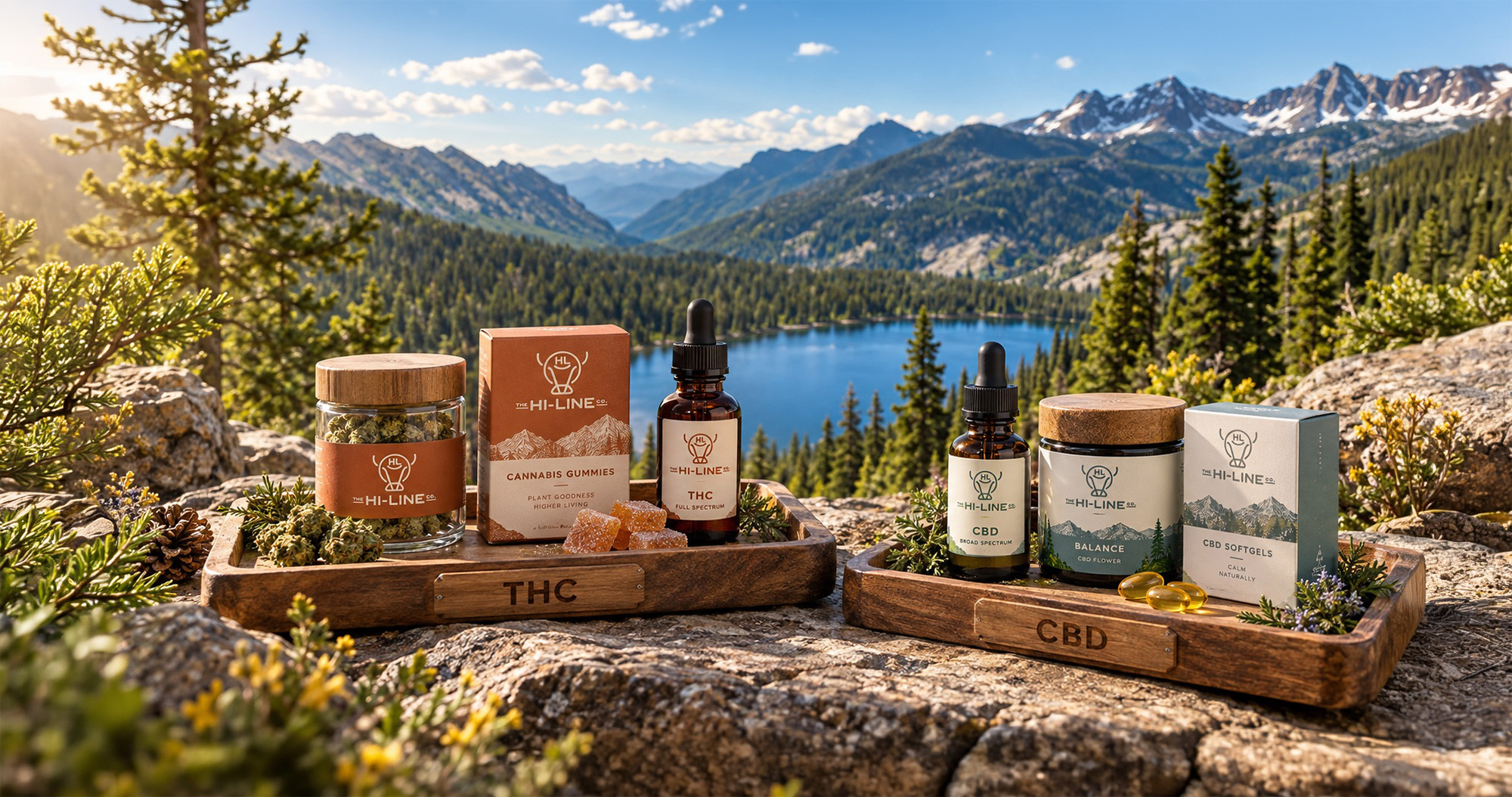
THC and CBD products from The Hi-Line Co. displayed on wooden trays overlooking Fish Lake in Montana Bitterroot Mountains

Cannabis Education & Shopping Confidence

THC vs CBD:What’s the Difference for Cannabis Shoppers?

CBD-only, CBD + THC, and THC-dominant products — explained through clear comparisons, practical label examples, and the details that matter.

What’s the Main Difference Between THC & CBD?

THC is the main cannabinoid responsible for cannabis intoxication. CBD does not produce that same intoxicating effect by itself. Both are compounds found in cannabis, and a product can contain one, the other, or both.

The useful comparison is not simply “which is better?” It is what the product contains, how much it contains, and which limitations matter to you. A cannabinoid name or ratio cannot predict a personal experience.

4-Question Starting Point

Which Cannabinoid Profile Should You Compare First?

Answer four questions about how you want THC and CBD to show up in the product. Your result gives you a starting profile to compare—CBD-focused, CBD + THC, THC-focused, or keep comparing all three.

JavaScript is off. Use these questions as a quick checklist:

  1. Is avoiding THC-related intoxication a firm priority?
  2. Are you specifically interested in a product containing both CBD and THC?
  3. Do THC:CBD ratios help describe what you want to compare?
  4. Before choosing, do you mainly need to confirm THC absence, the relationship between both compounds, or the actual THC amount?

Question 1 of 4
0 of 4 answered

Question


Start With the Comparison

CBD-Only, CBD + THC or THC-Dominant?

Keep the same three profiles in view while changing the question you are asking: the basic distinction, THC presence, amounts & ratios, or everyday cautions.

Compare the three profiles by:


CBD-only

Intended to contain CBD without THC.

The basic distinctionCBD itself does not produce THC’s characteristic intoxication. The full product still needs to be checked.

What to confirmThe CBD amount, whether THC is listed, and what the batch’s testing information reports.

CBD + THC

Both compounds are present; the proportions vary.

The basic distinctionThese products contain both CBD and THC. They may have similar amounts of each, more CBD, or more THC.

What to confirmThe ratio’s order and the actual amount of each compound in the same serving or quantity.

THC-dominant

More THC relative to CBD; CBD may still be present.

The basic distinctionTHC is the main cannabinoid responsible for cannabis intoxication. “Dominant” describes its proportion—not a fixed amount.

What to confirmThe actual THC concentration or amount, the format, and whether CBD is also listed.

CBD-only

Intended to contain CBD without THC.

THC presenceA “CBD” or “hemp” label alone is not proof that THC is absent. Some products carrying those labels contain THC.

Important boundary“CBD-dominant” means more CBD relative to THC—not necessarily no THC.

CBD + THC

Both compounds are present; the proportions vary.

THC presenceTHC is part of the formulation. A CBD-rich mixture is not the same as a THC-free product.

Important boundaryCBD should not be treated as reliable protection from THC-related intoxication or impairment.

THC-dominant

More THC relative to CBD; CBD may still be present.

THC presenceTHC is the larger share of the THC/CBD profile. A THC-dominant product may contain a little CBD or none.

Important boundaryThis label does not mean the same thing as “high dose.” Quantity must be read separately.

CBD-only

Intended to contain CBD without THC.

Amounts & ratiosLook for the CBD amount in a stated serving or quantity. A large number on the front may describe the entire package.

Read the complete labelIf THC is listed, the product is not CBD-only, even when the CBD amount is much larger.

CBD + THC

Both compounds are present; the proportions vary.

Amounts & ratiosTHC:CBD 1:2 means one part THC to two parts CBD. CBD:THC 1:2 describes the reverse.

Read the complete labelA ratio describes proportions. It does not reveal how many milligrams are in a serving.

THC-dominant

More THC relative to CBD; CBD may still be present.

Amounts & ratiosA hypothetical amount of 1 mg THC with no CBD and 5 mg THC with no CBD are both THC-dominant.

Read the complete labelThe second contains five times as much THC. These are arithmetic examples, not suggested servings.

CBD-only

Intended to contain CBD without THC.

Everyday cautionsCBD can cause drowsiness, other side effects, and medication interactions. Nonintoxicating does not mean risk-free.

Health questionsAsk a clinician or pharmacist about medications and personal health considerations.

CBD + THC

Both compounds are present; the proportions vary.

Everyday cautionsBoth compounds matter. The presence of CBD does not remove the need to account for THC-related impairment.

Check the formatAn edible can have a different timeline from an inhaled product, even with a similar cannabinoid ratio.

THC-dominant

More THC relative to CBD; CBD may still be present.

Everyday cautionsHigher amounts of THC can increase impairment and the risk of adverse effects. Prior experience is not a guarantee.

Plan around safetyTHC can affect reaction time, coordination, and judgment. Do not drive while impaired.


Explore the Details

Three Ways to Make a THC & CBD Label Easier to Read

Instead of treating every term as a separate lesson, group the label into three questions: what cannabinoids are present, how much is present, and what format you are comparing.


01 · Cannabinoid Profile

Start With What Is Actually Present

THC and CBD tell you about the product’s cannabinoid profile. They do not, by themselves, tell you how someone will respond.

THC

The Intoxicating Cannabinoid


THC stands for tetrahydrocannabinol. This guide uses THC to refer to delta-9 THC, rather than treating every THC variant as interchangeable.

THC can affect memory, coordination, and judgment. A higher concentration is not a measure of craftsmanship or a guarantee of a better experience.

For a measured product, read the milligrams in the stated serving. For flower or another concentration-based label, check the percentage and the quantity being described.

CBD

Nonintoxicating, Not Inactive


CBD stands for cannabidiol. It does not produce THC’s characteristic intoxication, but it can still affect the body and cause side effects.

A CBD amount describes an ingredient quantity. It is not proof that a product will help with sleep, stress, discomfort, or any other personal goal.

CBD may interact with medications. A clinician or pharmacist—not a product comparison—can address those health questions.

When the Product Contains Both CBD + THC

A CBD + THC product contains both cannabinoids, but that description alone does not tell you how much of either one is present. Some products contain similar amounts, while others are strongly CBD-dominant or THC-dominant. The ratio and the actual amounts need to be read together.

An indica/sativa “hybrid” is a different kind of description and should not be used to infer a CBD:THC ratio or a particular CBD amount.

Useful distinction: CBD-only, CBD-dominant, and a 1:1 mixture are three different descriptions. When avoiding THC matters, verify the THC information on the full label and available testing details rather than relying on the prominence of “CBD” on the package.

02 · Ratios & Amounts

A Ratio Shows the Relationship. The Amount Shows the Quantity.

Read both. The same THC:CBD ratio can describe very different quantities, and percentages and milligrams describe different measurements.

A ratio compares the amount of one compound with the other. Always read the order first. THC:CBD 2:1 and CBD:THC 2:1 describe opposite proportions.

Every example below uses THC:CBD order. The figures are simple arithmetic examples—not recommended servings, product listings, or predictions of effects.

THC:CBD 1:1

Equal amounts of THC and CBD

Illustrative amount:
2 mg THC + 2 mg CBD.

THC:CBD 2:1

Twice as much THC as CBD

Illustrative amount:
4 mg THC + 2 mg CBD.

THC:CBD 1:2

Twice as much CBD as THC

Illustrative amount:
2 mg THC + 4 mg CBD.

Dark blue = THC · Rust = CBD · Bar lengths show relative amounts only.

Same Ratio. Different Amounts.


1 mg THC + 1 mg CBD and 5 mg THC + 5 mg CBD are both 1:1. The second amount contains five times as much of each compound. The ratio stays the same; the quantities do not.

Does CBD Cancel Out THC?


Do not rely on CBD to cancel THC-related intoxication or make a THC-containing product safe for driving. The interaction is not a dependable offset that can be calculated from the package ratio.

In a randomized trial involving healthy, infrequent cannabis consumers, adding CBD to vaporized THC did not prevent the acute adverse effects measured at the ratios tested. That finding does not describe every person or formulation, but it is a clear reason not to treat a ratio as a safety guarantee.

Percentage vs Milligrams

Compare Like With Like

Percentages describe concentration. Milligrams describe an amount. Neither is meaningful without knowing the quantity or serving it applies to. Montana’s labeling guidance distinguishes percentage-based information for flower from milligram amounts for ingestible products.

Flower-Style Example

A Percentage Describes Concentration


If a label specifically reports a 20% THC concentration by weight, that corresponds to 200 mg of that stated THC measure per gram of material.

That is a concentration calculation—not the amount absorbed by the body and not a serving recommendation. Montana flower labels can distinguish THC, THCa, and total psychoactive THC, so compare the exact label field rather than treating every THC-related number as interchangeable.

Measured-Product Example

Milligrams Describe an Amount


A hypothetical edible labeled 5 mg THC per serving describes the amount in that stated serving, not necessarily the entire piece or package.

Look for the serving definition and serving count. Five milligrams in one serving and five milligrams in the entire package are different label statements.

03 · Labels & Formats

Read the Label Terms, Then Read the Format

The additional letters matter, but so does how the product is intended to be used. Keep those two questions together instead of treating them as separate shopping decisions.

THC & THCa

THCa, also written THCA, is the acidic precursor to THC. Heat can convert THCa into THC. A flower label listing little THC but substantial THCa should not be interpreted as THC-free when the product is heated.

CBD & CBDa

CBDa, also written CBDA, is the acidic precursor to CBD. Heat can convert CBDa into CBD. They are related compounds, but their separate label entries should not be casually substituted for one another.

Testing Information & COA

A Certificate of Analysis, or COA, reports laboratory results for a sample or batch. Check that the batch identifier matches the product, then review which compounds and amounts are actually reported. A CBD claim on the front of a package should not replace that review.

Product Format Still Matters

The Same Profile Can Behave Differently Across Formats

A cannabinoid profile tells you what compounds are present. Format tells you how the product is used and which additional details need attention.

01

Flower & Pre-Rolls


Review cannabinoid concentrations alongside net weight and the full THC/THCa information. A percentage alone does not describe the amount a person absorbs.

02

Edibles & Drinkables


Check the amount per serving, the serving count, and the package total. Effects can be delayed and last longer than expected; taking more too soon can lead to overconsumption.

03

Vapes & Concentrates


A concentrated format may contain a large proportion of THC. Net contents, concentration, and amount used are different details; none should be confused with a guaranteed personal response.

04

Tinctures, Capsules & Topicals


Confirm whether a product is swallowed, used under the tongue, or applied to the skin, and follow its labeled directions. Equal labeled milligrams across different formats do not guarantee the same timing or experience, so compare each product in the context of how it is intended to be used.


Reality Check

Common Shortcuts That Make the Comparison Less Clear

These are useful places to slow down and read the full label instead of letting one word or number make the decision for you.

01

“More THC Means a Better Product.”


A potency number is not a quality score. Higher amounts of THC can increase impairment and adverse effects, rather than simply improve an experience.

02

“CBD Means There Is No THC.”


CBD-dominant and CBD-only are not synonyms. Review THC separately, including when “CBD” or “hemp” is prominent on the package.

03

“A Balanced Ratio Means a Predictable Result.”


A 1:1 ratio describes equal amounts, not equal-and-opposite effects. The absolute amounts and format still matter.

04

“It Worked for Someone Else. It'll Work for Me.”


Someone else’s experience is not a personal guarantee. Prior exposure, amount, format, and other individual factors can change the response.

Before You Choose

Shop With Context, Not Just Cannabinoid Numbers

A useful comparison also includes the questions you still need answered, the circumstances around use, and the information Montana requires on the label.

Questions to Ask

Start With the Detail You Need Made Clear


You do not need the right terminology to ask a useful question.

  • Does this contain THC, CBD, or both—and where is each amount shown?
  • Is this ratio written THC:CBD or CBD:THC?
  • Do these milligrams apply to a serving, a piece, or the full package?
  • When you say “CBD-dominant,” how much THC is still present?
  • Can you help me match the product’s batch to its testing information?
  • Which directions, warnings, ingredients, and storage details should I review?

For questions involving a symptom, a medical condition, or medication interactions, take the label to a clinician or pharmacist. A retail explanation and a personal health assessment serve different purposes.

Montana Context

Use the Label, Not Just the Product Name


For adult readers across Western Montana and the Flathead region, the practical habit is the same: compare the actual label, not just the product’s name.

Montana’s guidance calls for cannabinoid information that varies by format, including THC/THCa and CBD/CBDa details. Ingestible labels also distinguish amounts per serving from amounts per package.

For the broader packaging walkthrough—including serving counts, testing references, and warnings—use our Montana cannabis label guide.

Health & Everyday Responsibilities

Keep the Circumstances Around Use in View

Driving, Equipment & Other Safety-Sensitive Tasks

THC can impair coordination, reaction time, and judgment. Do not drive or operate machinery while impaired, and do not use a CBD:THC ratio as a clearance to do so. Combining cannabis with alcohol can increase impairment.

Medications, Pregnancy & Health Concerns

CBD can interact with medicines and cause side effects. People who are pregnant or breastfeeding should avoid cannabis, including CBD, and discuss questions with their healthcare professional.

Delayed Effects & Secure Storage

With ingestible products, an immediate lack of noticeable effects is not proof that the product has had no effect. Avoid taking more too soon. Keep cannabis products secured in their original child-resistant packaging, away from children and pets.

The Hi-Line Co.

Cannabis Shopping Should Feel Clear, Not Complicated.

The Hi-Line Co. is a Montana-owned cannabis company built around approachable product education, consistent quality, and helping adult customers understand what they are comparing without assuming they already know every term on the label.

Understand Before You Choose

Clear Product Guidance


Our team can help explain cannabinoid profiles, serving information, product formats, testing references, and label language so the details are easier to compare.

Shop at Your Own Pace

Online or In Store


Research before you visit, browse current products online, or ask questions in store. The goal is a straightforward shopping experience rather than a rushed decision.

Local, Montana-Owned

Welcoming & Educational


The Hi-Line Co. is designed to feel approachable for newer customers while still giving returning shoppers the product information and consistency they expect.

FAQ: THC vs CBD

What is the main difference between THC and CBD?

THC is the main cannabinoid responsible for cannabis intoxication. CBD does not produce that same intoxicating effect by itself. Products can contain either compound or both, so the full label matters.

Can a CBD product contain THC?

Yes. CBD-dominant products can contain THC, and a CBD or hemp label alone is not proof that THC is absent. Review the cannabinoid amounts and the testing information for the specific batch.

What does a 1:1 THC:CBD ratio mean?

It means equal amounts of THC and CBD. It does not tell you how many milligrams are present or predict an effect. One milligram of each and five milligrams of each are both 1:1.

Is THC-dominant the same as high-dose?

No. THC-dominant describes the amount of THC relative to CBD. A small amount and a larger amount can both be THC-dominant. Read the actual quantity separately.

Does CBD cancel out THC?

CBD should not be relied on to cancel THC-related intoxication or impairment. Research in a randomized trial found no protection against the acute adverse effects measured at the CBD:THC ratios tested. A ratio is not a safety guarantee.

Does an indica/sativa hybrid mean it contains CBD and THC?

No. That strain description should not be used to infer a CBD amount. Look at the cannabinoid label to see whether CBD and THC are present and in what quantities.

Can CBD interact with prescription medications?

Yes. CBD can affect how other medicines work. A clinician or pharmacist should review medication and health questions; a label comparison is not a personal medical assessment.

Can this comparison help me narrow what to look for?

Yes. It can help you narrow whether to begin with CBD-focused, CBD + THC, or THC-focused products based on the preferences you identify. It cannot predict effects or replace medical guidance; the actual amounts, format, health considerations, and individual response still matter.

Can The Hi-Line Co. help explain THC and CBD labels?

Yes. The Hi-Line Co. team can help adult customers understand cannabinoid information, serving details, product formats, and testing references. Personal medical questions belong with a qualified healthcare professional.

Sources & Important Notes

General education for adults 21 and older. This article and its comparison are not medical advice, a product recommendation, or a promise of an effect. Consult a qualified healthcare professional about medical conditions, medications, pregnancy, or breastfeeding. Follow product warnings and current Montana requirements.

Numerical examples explain labels and arithmetic; they are not suggested servings or descriptions of available products. Health Canada resources are cited for cannabinoid characteristics, measurement, timing, and safety—not as a statement of Montana law. State labeling information is drawn from Montana’s own guidance.

Sources reviewed October 1, 2026. Rules, labeling requirements, and public-health guidance may change. The links below are provided for verification and further reading.

  1. Cannabis and cannabinoids: an overview
    NIH / NCCIH
  2. CBD: characteristics, labeling concerns, and risks
    CDC
  3. CBD: safety, side effects, and medication interactions
    FDA
  4. Randomized trial of four CBD:THC ratios
    Englund and colleagues · Neuropsychopharmacology, 2023
  5. Cannabis labeling and packaging guidance
    Montana Department of Revenue
  6. Cannabis amounts, formats, timing, and impairment
    Health Canada
  7. Cannabis edibles and poisoning risk
    CDC
  8. Cannabis and driving
    CDC
  9. Acidic cannabinoids and heat-related conversion
    Wang and colleagues · Cannabis and Cannabinoid Research, 2016
  10. THC, CBD, and the meaning of label amounts
    Health Canada

Back to the Comparison


The Hi-Line Co Dispensary Logo with words

You must be AT LEAST 21 years old to visit this site

Please , verify your age .