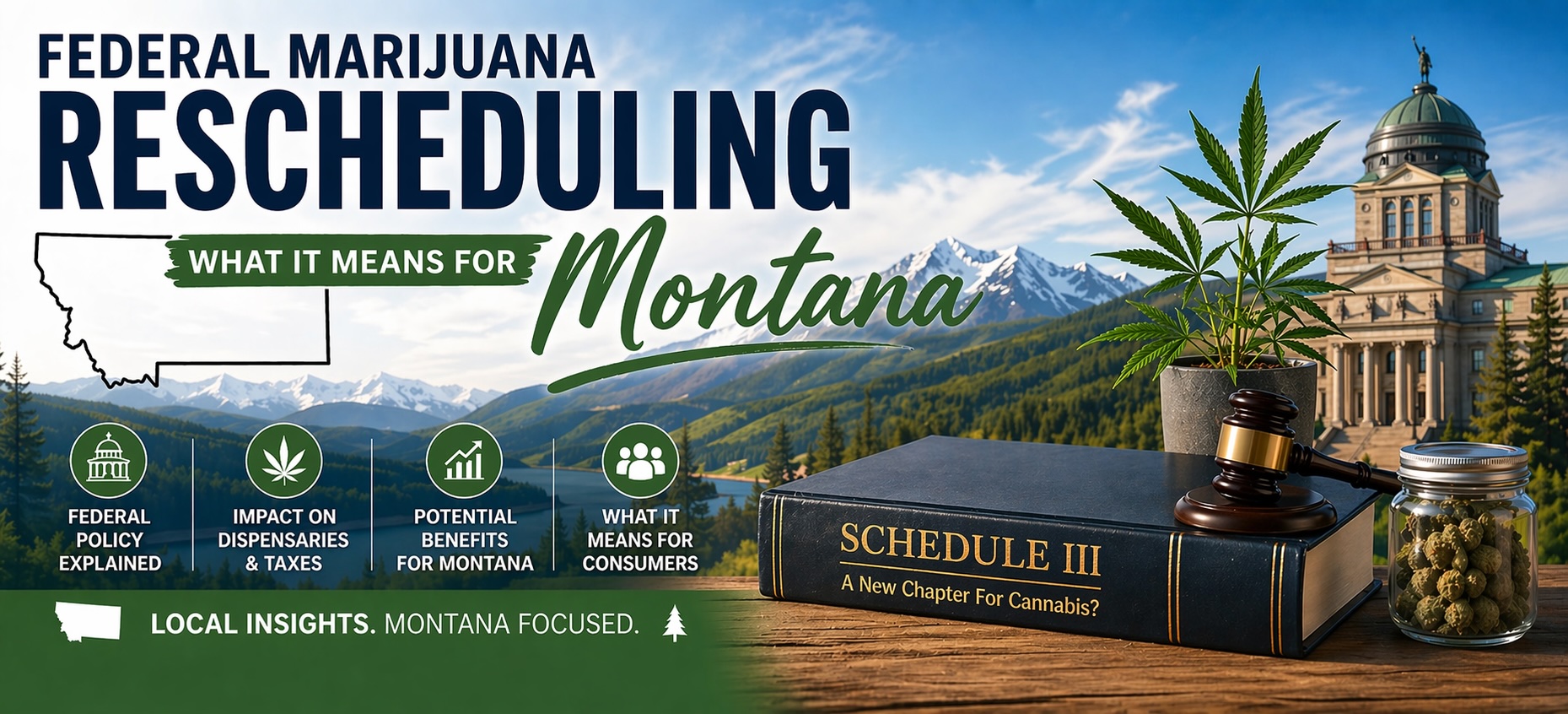
Federal Marijuana Rescheduling:
What It Means for Montana
Federal marijuana rescheduling may sound like a technical policy shift, but for cannabis businesses and consumers in Montana, it could have real-world effects. This is not full legalization, and it does not erase every challenge facing the industry. What it does signal is a meaningful change in how cannabis is viewed at the federal level, if fully implemented, especially when it comes to taxes, research, and long-term business stability.
For Montana, that matters. In a state where cannabis access often depends on trusted local dispensaries and rural communities still value consistency, education, and availability, structural changes at the federal level can carry more weight than they might in larger, denser markets.
Quick overview: the key takeaway
Federal marijuana rescheduling is an ongoing process that would move cannabis from Schedule I to Schedule III under federal law. That does not mean cannabis becomes fully legal nationwide, but it does represent a major shift in how the federal government classifies it.
The biggest potential impact is practical. Cannabis businesses could see relief from tax restrictions under IRS code 280E, greater financial stability, and stronger support for medical research. For customers, this may eventually contribute to better consistency, improved access, and a healthier long-term cannabis market.
In Montana, where communities are spread out and local dispensaries play an important role in access, that kind of change matters. It supports the businesses that serve real people across the state, not just the markets with the highest population density.
That is what makes this moment important. It is not the finish line, but it is a meaningful step toward a more workable future for cannabis.
What federal rescheduling actually means
For years, marijuana has remained classified as a Schedule I substance under federal law. That category has been reserved for substances considered to have a high potential for abuse and no accepted medical use.
Rescheduling would move marijuana to Schedule III, a category that recognizes medical value and carries a different regulatory framework. That change would not fully legalize cannabis at the federal level, but it would mark a major shift in how the government treats it.
Federal rescheduling does not happen all at once. Health and policy officials have recommended moving marijuana to Schedule III, but federal agencies must still go through a formal rulemaking process, which includes proposal, public comment, and final approval. The timing and exact details are still developing, and there is a possibility of legal challenges or policy changes along the way.
This matters because federal classification affects more than language. It shapes how cannabis businesses are taxed, how researchers study cannabis, how financial institutions assess risk, and how the broader industry is able to grow.
- It is not legalization — Cannabis would still remain federally regulated.
- It is a recognition of medical use — Schedule III reflects a different federal stance than Schedule I.
- It could improve how the industry functions — Especially in areas like taxes, research, and financial stability.

Why this matters for cannabis businesses
One of the biggest reasons cannabis businesses have struggled under federal law is not just legality, it is how the law affects day-to-day operations. Even in states with established legal markets, federal classification has created barriers that most other businesses do not face.
Tax relief could be one of the biggest changes
Cannabis businesses have long operated under IRS code 280E, which prevents them from deducting many normal operating expenses. That makes it harder to reinvest in staffing, product selection, customer education, and long-term growth.
If marijuana moves to Schedule III, those restrictions could ease. For dispensaries, that could mean:
- Healthier operating margins
- More room to invest in staff and customer experience
- Greater consistency in pricing and inventory
Until federal rescheduling is finalized and effective, cannabis businesses remain subject to existing 280E rules under federal tax law, and should continue to follow current guidance.
Financial stability matters too
Because cannabis remains federally restricted, many businesses still deal with banking friction and a complicated financial environment. Rescheduling may help reduce some of that pressure by signaling a lower level of federal risk.
That does not fix every problem overnight, but it can make the industry more stable, and stability helps both operators and customers.
Research and medical credibility could grow
A Schedule III classification would also support broader medical and scientific research. That matters because stronger research can help improve product understanding, patient education, and the overall clarity consumers have when choosing cannabis.
For newer consumers, returning consumers, and patients looking for more informed guidance, that is a meaningful step forward.
At The Hi-Line Co., we are closely following the federal rescheduling process and coordinating with professional advisors so that, when any changes become effective, we can focus the benefits on better service, stronger teams, and long-term access for Montana communities.
Why Montana feels this differently
Montana’s cannabis market is shaped by geography, community, and access. It is not driven only by dense city traffic or massive urban population centers. Local dispensaries serve customers across a large and spread-out state, and that makes consistency especially important.
When federal policy improves the business environment, it can have an outsized effect here.
- Rural access matters — Customers in Montana often rely on local dispensaries to provide dependable product availability and service.
- Local businesses matter — The cannabis market in Montana is built around community trust, not just scale.
- Operational stability matters — Better margins and less pressure can help support long-term service in the places people actually live.
What makes this especially relevant in Montana is that access is not always immediate. Better stability for dispensaries does not just help the business side. It helps strengthen the experience for the customer as well.

What this does not do
It is important to stay grounded. Federal rescheduling is meaningful, but it does not solve everything.
- It does not make cannabis federally legal
- It does not allow interstate cannabis transport
- It does not eliminate all regulation or compliance challenges
- It does not instantly change how Montana customers shop
This is progress, not completion. It is a step toward a more workable cannabis industry, but it is still one step in a longer process.
Where The Hi-Line Co. operates in Montana
The Hi-Line Co. operates dispensaries across Montana under multiple local storefront names, helping serve communities across the state with approachable, education-first cannabis retail.
You can find all Hi-Line Co. locations and order online here:
https://www.hi-line.co/locations/
Why this matters long term
Rescheduling is not the loudest cannabis policy story, but it may be one of the most important. That is because it changes how the system works behind the scenes, and those changes often shape the future more than a headline ever does.
For Montana, that means the potential for:
- Stronger local dispensaries
- Better long-term access across the state
- A more stable and credible cannabis market
- More room for education, consistency, and trust
For customers, the result may not be dramatic overnight. But over time, a healthier cannabis business environment can improve the quality and consistency of the entire experience.
That is what makes this important for Montana. It is not just a federal policy story. It is a local access story too.
FAQ: Federal Marijuana Rescheduling in Montana
Is marijuana becoming legal across the United States?
What is the difference between Schedule I and Schedule III?
Is rescheduling the same as legalization?
Could rescheduling help dispensaries in Montana?
Will this change how customers buy cannabis in Montana?
Could cannabis prices in Montana change if rescheduling happens?
Will this improve cannabis research?
Can I travel across state lines with cannabis if rescheduling happens?
Where does The Hi-Line Co. operate dispensaries?
Where can I find Hi-Line Co. locations and order online?

About The Hi-Line Co. Montana Dispensaries
The Hi-Line Co. is a Montana-owned cannabis company with dispensary locations across the state, built around a simple idea: cannabis should be approachable, well explained, and rooted in the communities it serves.
Whether you are brand new to cannabis or simply looking for a more informed experience, Hi-Line dispensaries focus on education first. Our teams help customers better understand product categories, cannabinoid balance, terpene profiles, and practical questions about how cannabis may fit into everyday life.
With thoughtfully curated, lab-tested products and a welcoming environment, The Hi-Line Co. is proud to serve communities across Montana with cannabis that feels accessible, grounded, and easier to navigate.
SOURCES & FURTHER READING
The following source informed the educational and policy context in this article:
- Associated Press. Coverage of the federal marijuana rescheduling proposal and what it could mean for cannabis policy, medical use, and the broader industry.
https://apnews.com/article/medical-marijuana-rescheduling-justice-department-trump-cannabis-1d6722d3aae122b1a91f8e4b6c690268
This article is for general informational and marketing purposes only and does not constitute legal, tax, or accounting advice. Cannabis laws and regulations continue to evolve at both the federal and state level. Readers should consult qualified legal and tax professionals about their specific situation before making decisions based on potential federal rescheduling or any changes to IRS rules, including section 280E.